· Diogo Silva · 8 min read
Giving the client the tools to decide
Most enterprise deals do not lose to a competitor; they die quietly in indecision. Helping a large organisation move requires both a Business Case for Finance and an Execution Blueprint for HR and Operations.
When a large enterprise opportunity goes quiet after three promising meetings, it is tempting to assume a competitor offered a lower price or a shinier feature. In my experience across a decade of B2B software sales, that is rarely what happened.
Most enterprise deals are not lost to another vendor. They are lost to no decision.
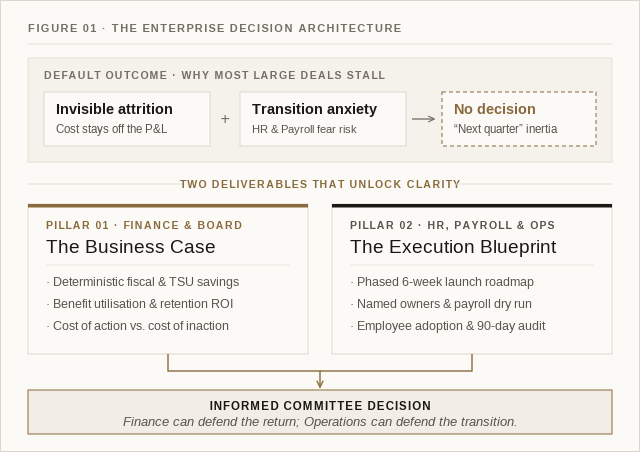
Large organisations are built to avoid unforced errors. Every executive in the room knows that saying yes carries visible personal risk: if a new compensation or benefits programme disrupts payroll, confuses five hundred employees, or fails to deliver the promised savings, everyone remembers who sponsored it. Saying “let us revisit this next quarter” carries no immediate penalty at all. The default decision in enterprise buying is always the status quo.
In employee benefits and compensation, this inertia has a specific root cause: most companies do not realise they have a talent retention problem until the cost has already compounded. Voluntary attrition does not arrive on the finance director’s desk as a single monthly invoice. It is dispersed across recruiting fees, agency commissions, empty seats, stretched managers, and six months of slow ramp-up for every replacement hire. Because the cost of inaction stays off the profit-and-loss statement, avoiding the purchase feels like prudence.
My job as an Account Executive is not to push a committee past its doubts. As I wrote on my Work page, good salespeople help people decide; they do not decide for them. When I work with a large logo, I build two distinct artefacts with the client before anyone is asked to sign: a Business Case for the finance team and the board, and an Execution Blueprint for HR, payroll, operations, and IT.
1. Why a product pitch cannot defeat the status quo
A feature demonstration answers the wrong question for an executive committee. By the time a 500- or 1,000-person organisation meets with a vendor, they usually accept that modern software works better than spreadsheets or legacy vouchers. What they cannot yet defend internally is why this change deserves capital, political attention, and operational bandwidth right now.
Every complex buying committee sits across a natural fault line. Finance asks whether the return is real, auditable, and resilient under conservative assumptions. HR, payroll, and operations ask whether the rollout will break their quarter, generate hundreds of support tickets, or create compliance exposure. If you answer only one side of that table, the other side quietly blocks the deal—usually without ever raising its voice.
Giving the client the tools to decide means arming both halves of the organisation with a document written in their own language, built from their own numbers, that they can carry into internal meetings when you are not in the room.
2. Pillar 01: The Business Case — proving the ROI of benefit utilisation
A serious Business Case is not a marketing slide with inflated projections. It is a transparent financial model designed to survive scrutiny from a sceptical CFO. In benefits and compensation, the goal is to demonstrate an unmistakable return on investment in the actual utilisation of benefits—not merely in having benefits listed in an onboarding PDF that nobody reads.
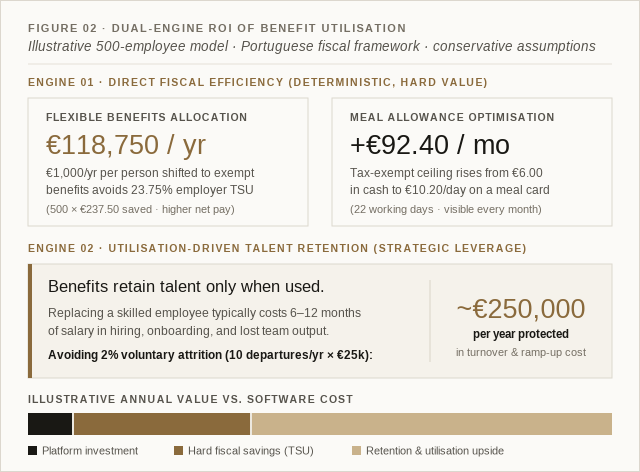
In practice, the return rests on two complementary engines. Consider an illustrative, conservative model for a 500-employee organisation operating under the Portuguese fiscal framework:
- Engine 01 — Direct fiscal efficiency (deterministic savings): Tax law is not probabilistic; as I argued in The end of the information broker, every fiscal calculation must be deterministic and verifiable to the cent. In Portugal, shifting €1,000 per employee per year from standard gross compensation into tax-exempt flexible benefits (such as childcare, education, health, or retirement savings) avoids the 23.75% employer Social Security contribution (TSU). That is €237.50 saved per employee—€118,750 per year across 500 people—while simultaneously increasing the employee’s net purchasing power without expanding payroll cost. Likewise, moving the statutory meal allowance from €6.00 per day in cash to €10.20 per day on a meal card opens €4.20 per day—€92.40 per working month—in additional tax-exempt value directly in the employee’s pocket.
- Engine 02 — Utilisation-driven retention (strategic leverage): Fiscal savings justify the budget; utilisation drives the much larger business return. A benefit that employees cannot easily understand or spend creates zero loyalty. When people use their benefits every month—paying for nursery fees, public transport, health expenses, or daily meals through a single clear wallet—total compensation stops being an abstract annual figure and becomes a tangible part of household life. Replacing a skilled employee routinely costs six to twelve months of salary in recruitment, onboarding, and lost productivity. In a 500-person company, avoiding just two percentage points of voluntary attrition—ten departures a year at a conservative €25,000 replacement cost each—protects roughly €250,000 per year.
One discipline makes or breaks this stage: the Business Case must be co-authored with the client. I never present a locked PDF as final truth. We put the company’s actual headcount, current benefit mix, and real HR turnover rate into the model together, then stress-test the conservative case. If the Finance Director cuts the retention assumption in half and the hard fiscal savings alone still pay for the platform several times over, the scepticism dissolves. At that point, the Business Case is no longer a vendor’s argument; it is Finance’s own analysis.
3. Pillar 02: The Execution Blueprint — de-risking HR, Payroll, and Operations
Many enterprise salespeople stop the moment the CFO agrees the numbers make sense. That is where deals mysteriously stall for another four months.
Approving a Business Case in a board meeting is one thing; changing how five hundred or two thousand people receive their benefits on the twenty-fifth of every month is another. For an HR Director, a Payroll Manager, or an Operations Lead, the primary fear is not the software licence fee. It is the transition: ERP export mismatches, tax classification edge cases, unclear ownership between internal departments, and an inbox full of confused employees on launch week.
If those teams cannot picture the exact path from signature to a calm first payroll run, they will delay the project—not out of stubbornness, but out of professional responsibility. Their job is to protect the operational continuity of the company.
To respect that responsibility, I prepare an Execution Blueprint alongside the Business Case, well before any contract is signed. It is a working operational plan that turns an abstract migration into four bounded phases, with named owners on both sides and explicit exit checks before advancing:
- Scope, fiscal rules, and payroll mapping (Weeks 1–2): Finance, Payroll, and vendor solutions specialists lock the eligible benefit categories, tax rules, and ERP export formats, ending with a signed technical specification.
- Configuration and parallel payroll dry run (Weeks 3–4): Before a single employee sees the platform, Payroll, IT, and the implementation lead run a simulated cycle alongside live payroll. Nothing goes live until the reconciliation file matches cleanly.
- Internal communication and workforce rollout (Weeks 5–6): HR, Internal Communications, and Customer Success brief people managers, distribute plain-language employee guides, run live Q&A sessions, and oversee card and wallet activation. High utilisation starts here—not after launch.
- Utilisation audit and Business Case review (Day 60–90): Once the programme has run through real monthly cycles, Finance, HR, and the Account Executive sit down to compare actual employee usage and tax savings against the original Business Case.
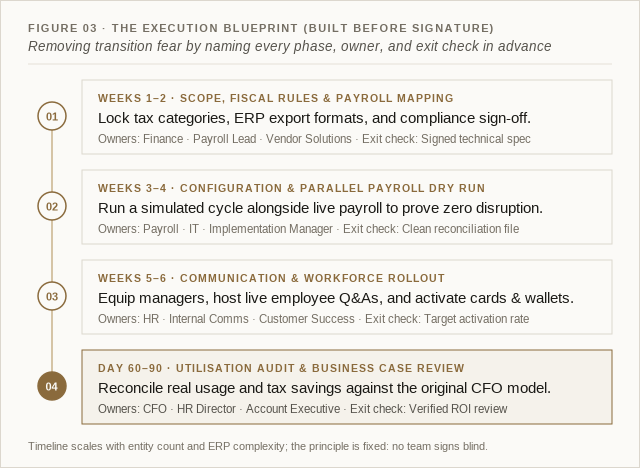
Notice what happens to the internal conversation once this blueprint is on the table. Payroll sees the parallel dry run and knows live salaries will not be endangered. HR sees the communication kit and live Q&A sessions and knows their team will not be left alone to answer five hundred individual emails. And the CFO sees a 90-day utilisation audit that closes the loop on the original financial model. The two documents reinforce each other: the Business Case explains why the change is worth making; the Execution Blueprint proves how it will succeed without breaking the organisation.
4. Maximum clarity, not maximum pressure
Preparing both documents properly takes real work—and it is one of the main reasons I invest in internal workflows to clear away administrative clutter so I have the time to build them carefully for each account. A generic template fools nobody in an enterprise boardroom.
There is also an honesty built into this approach that I value. When you lay out deterministic tax maths, conservative retention assumptions, and a candid map of the hours required from Payroll and HR, you are not trying to manoeuvre a buyer into a corner. You are putting every material fact on the table in plain sight.
Sometimes, after reviewing both documents, a company concludes that an ERP migration or a restructuring means this genuinely is not the right quarter. That is not a failure; it is a clean, respectful decision that preserves trust for when the timing is right. Far more often, however, a buying committee that felt stuck between an invisible retention problem and a frightening operational transition discovers it finally has everything required to act.
In enterprise sales, you do not close a large logo by talking louder than the status quo. You win by giving Finance the rigour to defend the return, giving HR and Operations the blueprint to defend the rollout, and leaving the client with the clearest possible tools to decide.